

The Tabnine AI code assistant is one of the most widely used tools for developers who want faster, smarter code completion directly inside their IDE. In this guide, we explore how the Tabnine AI code assistant works, its strengths, limitations, and how it compares with modern full-stack AI builders like PromptXL.
Among the earliest and most trusted names in this space is Tabnine.
But as AI tools mature, developers are no longer satisfied with tools that only help write lines of code. They want tools that help them build entire applications.
This article explains exactly where Tabnine excels, where it falls short, and why many teams are now moving toward system-level AI builders like PromptXL.

What Is the Tabnine AI Code Assistant?
Tabnine is an AI-powered code assistant designed to integrate directly into your IDE and provide intelligent code completion, suggestions, and refactoring support.
Unlike chat-based tools, Tabnine works in the background as you code, predicting what you intend to write next.
It supports:
- VS Code
- JetBrains IDEs (IntelliJ, PyCharm, WebStorm)
- Eclipse
- Sublime Text
How the Tabnine AI Code Assistant Works
Tabnine is powered by proprietary machine-learning models trained on high-quality open-source repositories. It analyzes:
- Your current file
- Nearby code context
- Naming conventions
- Your project structure
Then it generates code suggestions in real time.
It does not rely solely on internet models — enterprises can run self-hosted models to ensure their code never leaves their infrastructure.
Core Features of the Tabnine AI Code Assistant
1. Context-Aware Code Completion
Tabnine doesn’t just autocomplete variables. It understands intent:
- Suggests entire functions
- Generates boilerplate patterns
- Adapts to your coding style
This saves time on repetitive patterns.
2. Multi-Language Support
Tabnine supports over 20 major languages, including:
- JavaScript / TypeScript
- Python
- Ruby
- Java
- Go
- PHP
- C#, C++
This makes it suitable for polyglot teams.
3. Enterprise-Grade Privacy
One of Tabnine’s strongest differentiators is privacy:
- Self-hosted deployment
- Zero data retention
- Private LLM options
- SOC-2 and enterprise governance controls
This is why it is heavily adopted by large organizations.
4. IDE-Native Experience
There is no separate dashboard or workflow. Tabnine lives inside your editor, making it feel like a natural extension of your coding environment.
Why Developers Search for Tabnine
Typical developer search intent includes:
- “Tabnine vs GitHub Copilot”
- “Best AI coding assistant 2026”
- “AI code completion for VS Code”
- “Private AI code assistant for enterprise”
This shows that developers are looking for:
- Productivity
- Security
- Reliability
- IDE-native workflows
Limitations of the Tabnine AI Code Assistant
Despite all its strengths, Tabnine has a fundamental limitation:
It improves how you write code, but it does not build systems.
What Tabnine does not do:
- It does not create project architecture
- It does not design databases
- It does not configure authentication
- It does not generate CI pipelines
- It does not deploy applications
You must still:
- Design the architecture
- Wire the frontend and backend
- Create migrations
- Configure environments
- Handle hosting and infrastructure
Tabnine saves minutes.
It does not save weeks.
The Rise of “Vibe Coding” – And Its Problems
Many developers now describe their workflow as vibe coding:
Prompt → AI writes code → hope it works.
This works for snippets, but when building real systems:
- Hidden bugs multiply
- Technical debt increases
- Architecture becomes inconsistent
- Security risks rise
Industry leaders are already warning that vibe coding without structure leads to fragile software.
Enter PromptXL – The System Builder
This is where the next generation of AI tools begins.
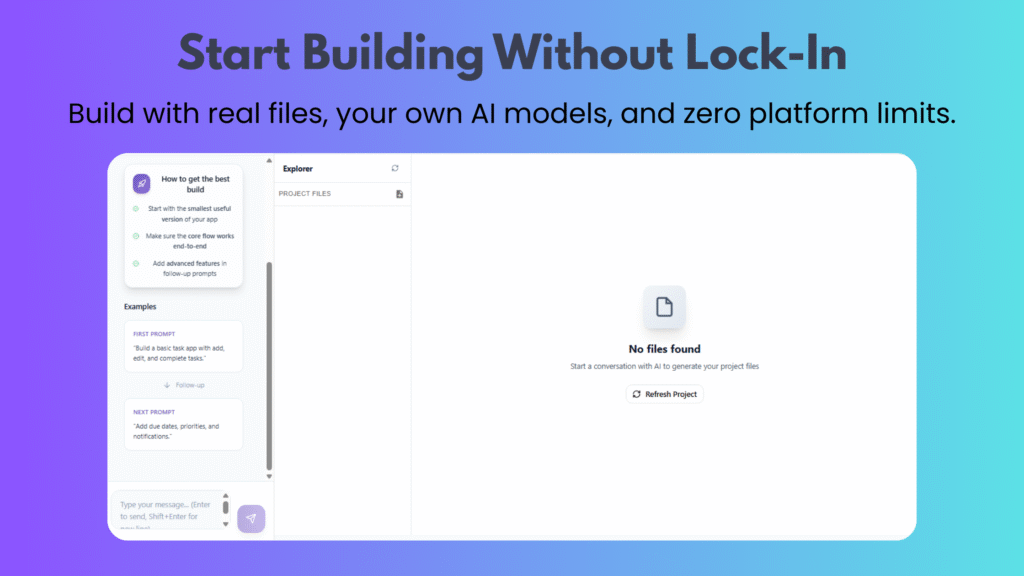
PromptXL is not a code assistant.
It is a full-stack AI application builder.
What PromptXL does differently
| Traditional AI Tools (Tabnine, Copilot) | PromptXL |
|---|---|
| Work at file level | Works at system level |
| Suggest lines of code | Generates entire applications |
| No architecture control | Architecture-aware |
| No deployment | One-click deploy |
| IDE-only | Idea → Production pipeline |
| Model-locked | Bring your own LLM keys |
How a PromptXL Workflow Looks
- Describe your idea
- PromptXL generates:
- Frontend
- Backend
- Database schema
- Authentication system
- CI-safe deployment configs
- Export the project to your repository
- Deploy to Vercel + Supabase instantly
No lock-in. No black boxes.
Tabnine AI Code Assistant vs PromptXL
| Your Need | Best Tool |
|---|---|
| Writing faster code inside IDE | Tabnine |
| Enterprise privacy requirements | Tabnine |
| Building production apps from scratch | PromptXL |
| Architecture, auth, database, deploy in minutes | PromptXL |
| Owning your stack & infrastructure | PromptXL |
Final Thoughts
Tabnine remains one of the best AI coding assistants in the world. It is ideal for enhancing daily productivity.
But the future of software development is not about typing faster — it is about building systems faster.
That future belongs to platforms like PromptXL.
Stop vibe coding.
Start building real software with AI.