


Developers frequently ask:
How does Lovable Cloud work, and what actually happens when you deploy an AI-generated app inside Lovable.dev? This question has become increasingly common as developers try to understand Lovable Cloud hosting, backend functions, database structure, and long-term limitations such as vendor lock-in.
- Where is the frontend hosted?
- Is the backend running on serverless functions?
- What database does Lovable Cloud use?
- Why can’t I choose my own hosting provider?
- Is Lovable Cloud creating vendor lock-in?
This guide explains exactly how Lovable Cloud hosting, backend execution, and database management work, and why many teams eventually run into limitations.
We also explore PromptXL — a modern alternative that avoids vendor lock-in and supports open, developer-friendly hosting such as Vercel + Supabase.
How Does Lovable Cloud Work and Why Does It Matter?
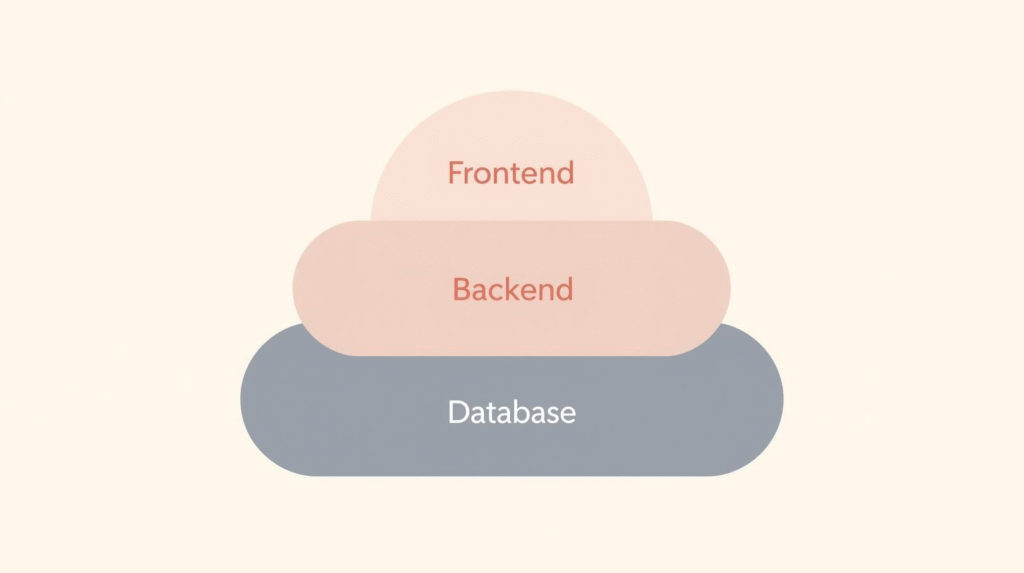
Lovable Cloud is the fully managed hosting environment behind every Lovable.dev project. When you click Deploy, the platform automatically provisions and manages:
- Frontend hosting
- Backend/serverless functions
- A managed database
- Environment variables
- Build and deployment pipeline
- Routing and API endpoints
In simple terms:
Lovable Cloud = frontend + backend + database + deployments — all abstracted away from the user.
This makes deployment extremely simple for beginners, but it also creates strict constraints for developers who need scalability, transparency, or infrastructure-level control.
How Does Lovable Cloud Work for Hosting?
Lovable Cloud is composed of three tightly coupled layers: frontend hosting, backend functions, and an internal database. All of them operate inside Lovable’s private infrastructure, not on open platforms.
1. Frontend Hosting (Static + Dynamic Next.js Pages)
Lovable automatically builds and deploys your frontend — typically React/Next.js — to its own hosting stack. Developers cannot access or modify:
- build configurations
- caching policies
- CDN settings
- routing logic
- environment modes
- framework versioning
The result:
The frontend runs reliably, but cannot be optimized, tuned, or extended as you would on Vercel, Netlify, or Render.
2. Backend Hosting (Serverless Functions You Cannot Configure)
Lovable Cloud deploys backend logic as serverless functions similar to:
- Vercel Functions
- AWS Lambda
- Netlify Functions
However, Lovable developers face major limitations:
- No control over runtime versions
- No background workers or cron jobs
- No custom frameworks
- No advanced logging or observability
- No external service attachments
- No custom middleware or routing layers
The backend “just works,” but it cannot be shaped into a production-grade architecture.
3. Database Layer (Managed, Hidden, and Not Configurable)
Lovable Cloud automatically provisions a fully managed database, but provides no transparency or control.
Developers cannot influence:
- database engine (Postgres, MySQL, MongoDB, etc.)
- schema evolution
- migrations
- scaling rules
- indexing
- SQL dashboards
- permissioning
- connection pooling
Additionally, exports often break because Lovable sometimes regenerates backend logic in ways that no longer match the database structure.
Convenient in the beginning, but highly limiting as your app matures.
The Real Issue: Lovable Cloud Vendor Lock-In

Lovable Cloud gives a smooth early experience, but the deeper your app becomes, the harder it is to escape the ecosystem.
Here’s what developers usually discover:
1. You Cannot Move to Other Hosting Providers Without Rebuilding
Exports require significant manual work:
- backend rewiring
- recreating environment variable handling
- database migration or reconstruction
- rewriting API routes
- fixing build errors
- restructuring server functions
Because Lovable hides the underlying architecture, exported apps rarely run cleanly on external infrastructure.
2. You Cannot Bring Your Own Infrastructure (Vercel, Supabase, AWS, etc.)
Lovable Cloud does not allow deployment or integration with:
- Vercel
- Supabase
- AWS
- Render
- DigitalOcean
- Fly.io
- Neon / PlanetScale
- Custom Docker hosting
This restricts developers who want:
- cheaper long-term hosting
- better monitoring and logs
- scalable databases
- custom APIs
- enterprise-grade infrastructure
3. You Cannot Choose Your LLM or Bring Your Own API Key
All AI generations are tied to Lovable’s internal LLM stack.
You cannot choose:
- GPT-4.1 or GPT-4o
- Claude 3.7 Sonnet or Opus
- Gemini 2.0 Flash or Pro
- Mistral Large
- Groq models
- Your own OpenAI/Anthropic/Google keys
This increases dependency and prevents upgrades using best-in-class models.
4. No Clear Separation Between Development and Production Environments
Everything deploys the same way. You cannot easily:
- run a staging environment
- preview changes before production
- deploy feature branches
- manage rollback strategies
This is a major limitation for real businesses and engineering teams.
How PromptXL’s Multi-LLM System Works Compared to Lovable Cloud
PromptXL is engineered to avoid the architectural restrictions imposed by Lovable Cloud.
It brings transparent control, open hosting, and multi-LLM support to the same “vibe coding” workflow.
1. PromptXL Deploys Directly to Vercel + Supabase
Today, PromptXL supports:
- Frontend deployments on Vercel
- Backend + database hosting on Supabase
These platforms provide:
- full dashboards
- detailed logs
- SQL editor
- metrics and monitoring
- scalable infrastructure
- predictable pricing
- superior reliability
With PromptXL, your application runs on real, industry-standard infrastructure you control.
2. More Hosting Providers Coming Soon
PromptXL’s roadmap includes:
- DigitalOcean
- Render
- Fly.io
- AWS
- Custom self-hosting
- Bring-your-own database (Supabase, Neon, PlanetScale)
Unlike Lovable Cloud, PromptXL never locks you into a single provider.
Build once → deploy anywhere.
3. Full Multi-LLM Support (GPT, Claude, Gemini, Mistral, Groq)
PromptXL lets you pick the best model for each task, including:
- OpenAI GPT
- Anthropic Claude
- Google Gemini
- Mistral
- Groq Llama models
You can also bring your own API key (BYOK) for maximum transparency and cost efficiency.
No credits. | No throttling. | No hidden charges.
4. Transparent, Controlled Code Generation
PromptXL provides:
- visible system prompts
- diff-based file editing (accept/reject)
- safe internal preview environment
- stable production deployment
- version-aware generations
- no full-file rewrites unless requested
This eliminates Lovable’s unpredictability and gives developers real control over app evolution.
Final Thoughts: How Does Lovable Cloud Work Long-Term for Developers?
Lovable Cloud is excellent for:
- prototypes
- idea validation
- hackathon apps
- early founder experiments
- fast UI generation
But as soon as your needs become real — scalability, transparency, stable versions, environment control, custom hosting — Lovable Cloud hits hard limitations.
PromptXL removes all of those barriers, offering:
- No vendor lock-in
- Vercel + Supabase hosting (today)
- More hosting options coming
- Multiple LLMs + BYOK
- Full transparency and stable iteration
- Production-grade infrastructure
Lovable introduced the magic of vibe coding.
PromptXL brings the magic — without the walls.
PromptXL — Build smarter. Ship faster. Create without limits.
Related Topic: Lovable Pricing in India 2026: INR Costs, Issues & Alternatives