

As AI tools reshape how software is built, many developers now search for Capacity.so vs PromptXL to find which platform best matches their development goals. Although both tools use AI to accelerate creation, they take very different approaches. Capacity.so focuses on a structured, often Supabase-powered web development workflow, while PromptXL centers on developer control, multi-model flexibility, and real file ownership.
What Is Capacity.so?
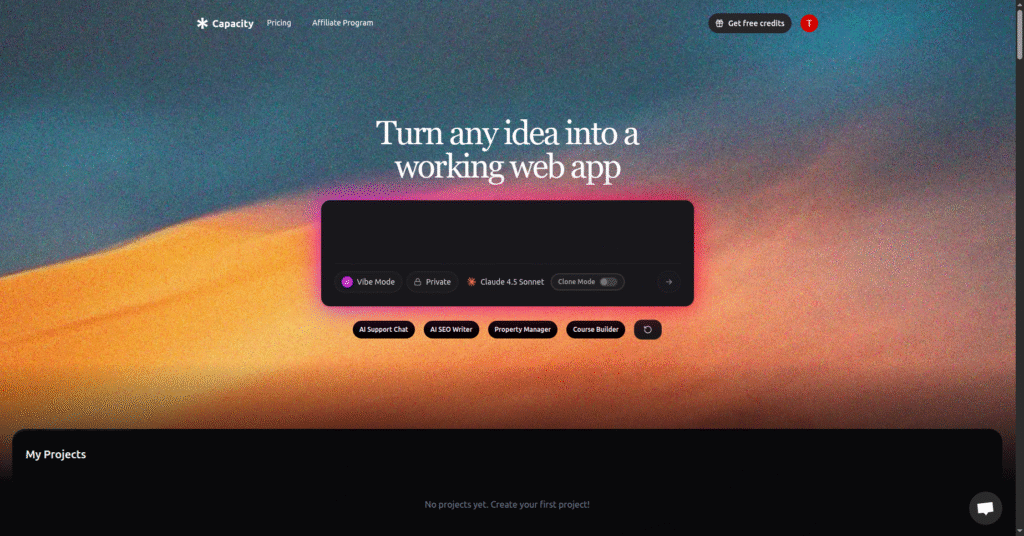
Capacity.so is an AI-assisted development platform that helps teams rapidly build web applications with a structured stack. It is designed to simplify full-stack workflows by providing built-in tools and integrations, often oriented around Supabase, Next.js, and team collaboration.
In everyday use, Capacity.so offers:
- AI-assisted page generation and components
- Supabase backend integration
- Team workspaces and shared projects
- A visual dashboard to manage resources
- Export and integration options
As a result, teams that want a structured, integrated environment may find Capacity.so appealing.
Capacity.so Stack Output and Tools
Capacity.so projects typically produce:
- Next.js + React frontend
- Supabase backend support
- Tailwind CSS
- Built-in hosting or export options
Developers can also:
- Preview builds
- Connect external services
- Use Supabase for database and auth
However, the environment is more guided than bare-metal code projects.
AI Model and Features in Capacity.so
Capacity.so uses AI to help:
- Generate UI and pages
- Suggest code snippets
- Build workflows
The platform’s AI operates behind the scenes to assist development, but it typically does not give developers direct control over specific AI models like Claude or Gemini.
This makes Capacity.so easier to use for beginners, but limits model choice and fine-tuning for advanced developers.
Capacity.so Limitations
While Capacity.so simplifies full-stack workflows, it has trade-offs:
- Less control over underlying code structure
- Platform-defined workflows limit customization
- AI model choices are internal only
- Scaling depends on platform guidelines
Therefore, it works well for teams seeking integration and speed, rather than deep architectural control.
What Is PromptXL?
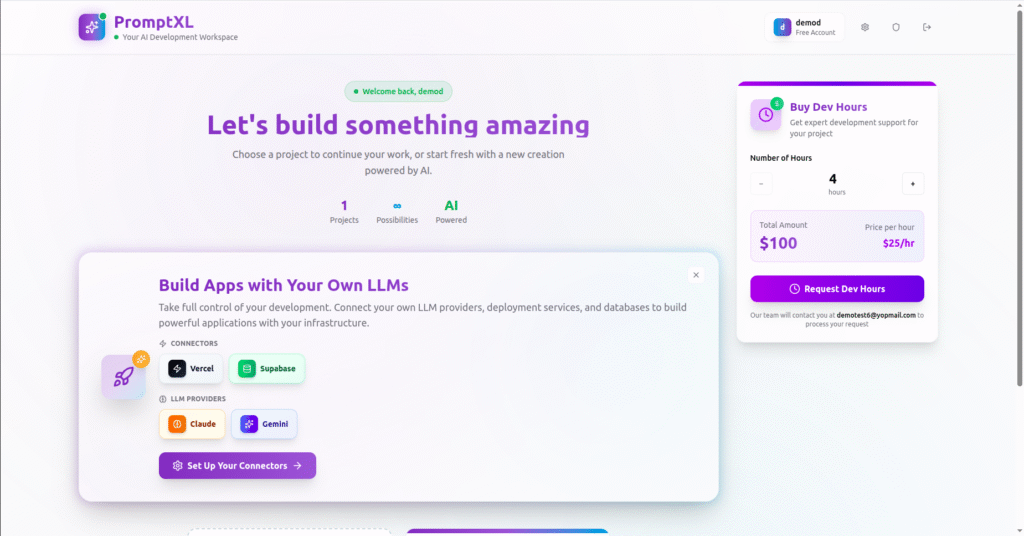
PromptXL is a developer-first AI build system designed to give teams full architectural control while using AI to accelerate development.
Unlike Capacity.so’s guided workflow, PromptXL focuses on:
- Real file-based projects
- Full code ownership
- Multi-LLM support
- Bring-your-own API keys
- Developer workflows (VS Code, GitHub, local builds)
In contrast, PromptXL leaves decisions like backend choice, hosting, and model routing in the hands of developers.
PromptXL Core Advantages Over Capacity.so
Full Code and File Ownership (Capacity.so vs PromptXL)
PromptXL generates real project files from day one.
Therefore, developers keep full ownership and can move the code anywhere without lock-in.
Multi-LLM Flexibility
PromptXL supports multiple large language models, including:
- Claude
- Gemini
- OpenAI (coming soon)
- Groq, Qwen, and DeepSeek (planned)
As a result, developers can pick the right model for each task.
Choice of Tools and Stack
With PromptXL:
- You choose your stack (Next.js, Rails, Flask, Express, etc.)
- You choose your hosting provider
- You choose your backend and database
Consequently, PromptXL fits teams that want complete technical freedom.
Optional Credit Usage
PromptXL allows credits, but it also lets teams bring their own API keys to avoid forced usage limits.
Therefore, developers can control cost and AI routing.
Capacity.so vs PromptXL – Feature Comparison
| Feature | Capacity.so | PromptXL |
|---|---|---|
| Pricing Model | Subscription-oriented | BYO API + optional credits |
| Stack Output | Next.js/React + Supabase | Any stack |
| AI Model Control | Internal only | Multi-LLM |
| Backend Choice | Supabase | Developer choice |
| File Ownership | Partial | Full |
| Vendor Lock-in | Medium | None |
| Hot Reload / Dev | Platform previews | Local dev |
| Deployment | Built-in | Developer choice |
| Best for | Guided web apps | Flexible long-term software |
When Capacity.so Makes Sense
Choose Capacity.so if you:
- Want guided workflow with fewer decisions
- Prefer close Supabase integration
- Need quick prototypes
- Work within a team that values simplicity
- Like builtin auth and database support
In short, Capacity.so fits teams that want structure and speed over architectural freedom.
When PromptXL Is the Better Choice
Choose PromptXL if you want:
- Full ownership of code
- Open AI model choice
- Freedom to define your stack and hosting
- No forced usage limits
- Software that scales beyond platform constraints
Overall, PromptXL is built for developers who expect their applications to evolve without limits.
Final Verdict: Capacity.so vs PromptXL
Ultimately, Capacity.so is a structured AI development platform that guides teams through web app creation with integrated tools. Meanwhile, PromptXL is a flexible, developer-first AI build system that gives teams control over every technical decision.
If your priority is quick prototyping and guided workflows, Capacity.so is a strong option.
However, if your goal is long-term architectural freedom and full code ownership, PromptXL is the better long-term choice.
🚀 Build With Control or Simplicity
Create your project: https://app.promptxl.com
Learn more: https://promptxl.com
Build with real files, multi-LLM intelligence, and zero platform lock-in.